
Flagship engineering project
Serixa
Widget composition for server-rendered PHP
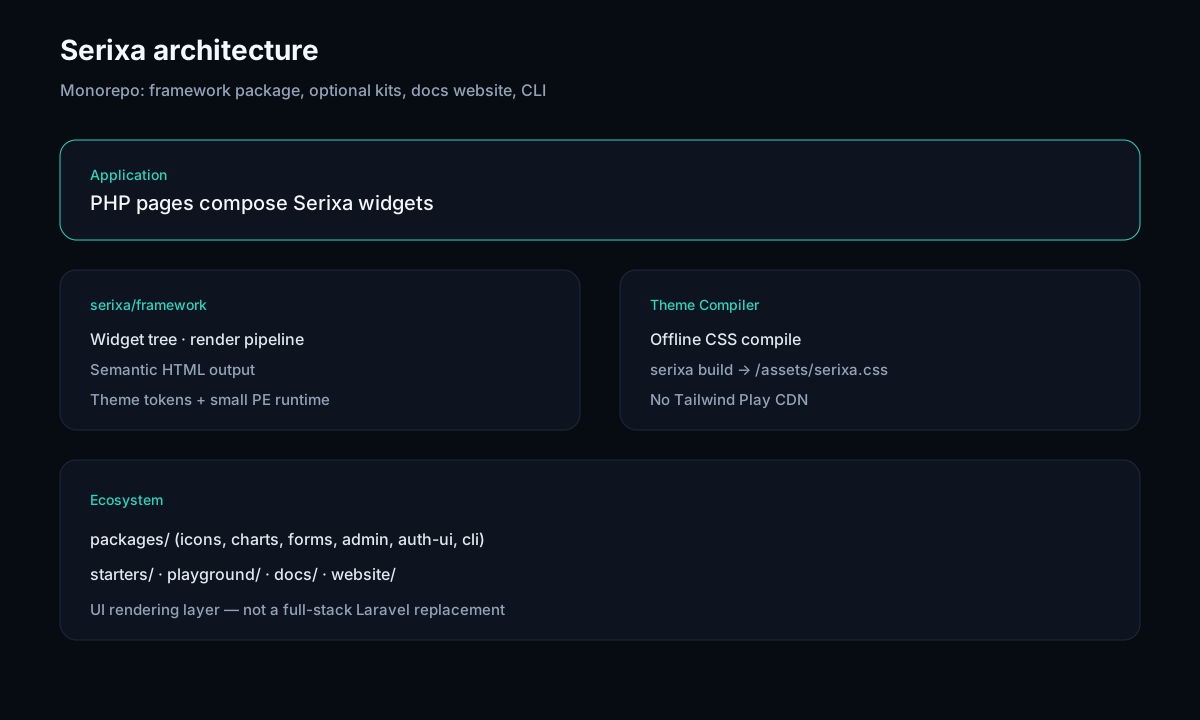
An open-source Flutter-inspired PHP UI framework for building server-rendered applications using reusable PHP widgets and a widget-tree architecture. It emits semantic HTML, compiles CSS from themes and design tokens, and can load a small progressive-enhancement runtime when interactivity is needed.
Architecture
PHP widgets → HTML / CSS pipeline
Hover or focus a stage · not Laravel / not a SPA
Overview
Composition feels familiar if you have used Flutter or React components, but the tree is rendered on the server in PHP. Serixa owns the UI layer - widgets, HTML, themes, and optional progressive enhancement. Applications still own routing, persistence, and authentication.
Motivation
The problem with traditional PHP templating
Why Serixa was created
Serixa is not a full-stack application framework. Core has no router, ORM, auth system, sessions, or job queue. Embed widgets in an existing PHP app, or scaffold a thin shell and bring your own backend.
Widget tree architecture
- 1
Developer
Describe UI in PHP only
- 2
PHP widgets
Button, Card, Column, Row, ...
- 3
Widget tree
WidgetTree materialised from the root
- 4
Render pipeline
BuildTree → ResolveContext → Lifecycle → Theme → Accessibility → Render
- 5
Semantic HTML
Fragments or full Document pages
- 6
Theme Compiler
Tokens and recipes → /assets/serixa.css
- 7
Browser
HTML + CSS; optional ~21 KB serixa.js runtime
Default render passes
How widgets become HTML
App widgets enter Renderer. Full pages go through DocumentRenderer. Fragments run the ordered RenderPipeline, then HtmlWriter emits the HTML string. Themes resolve class maps before render. Accessibility passes run before the final HTML write.
Theme system, design tokens, CSS compilation
Theme system
Design tokens
CSS compiler
Component composition
Developers build UI without manually writing HTML for the common cases. Layout and content widgets nest like Flutter widgets or React components, then render to real HTML elements.
Container
Constrains width and wraps a child subtree (for example maxWidth('md')).
Column / Row
Flex layouts for vertical or horizontal composition with gap and alignment helpers.
Text
Typography widget with tone helpers such as muted, instead of raw paragraph markup.
Button
Semantic button with primary/secondary/danger/ghost, sizes, and optional DOM events.
Card
Article-like surface with title and nested children for grouped content.
Scaffold / AppBar
Application chrome for shell layouts (app bar, sidebar, body, footer).
Example widget code
use Serixa\Component\Button;
use Serixa\Component\Card;
use Serixa\Component\Center;
use Serixa\Component\Column;
use Serixa\Component\Container;
use Serixa\Component\SizedBox;
use Serixa\Component\Text;
use Serixa\Rendering\Renderer;

$ui = Container::make(
 Center::make(
 Column::make([
 Card::make()
 ->title('SERIXA')
 ->child(
 Text::make('Write PHP. Get semantic HTML.')
 ->tone('muted'),
 )
 ->child(SizedBox::height(4))
 ->child(
 Button::make('Get started')
 ->primary()
 ->large(),
 ),
 ])->alignCenter()->gap(4),
 ),
)->maxWidth('md');

echo (new Renderer())->render($ui);
Button::render() emits a real <button> with theme classes and escaped label text. Card renders an <article> with an optional header. Layout widgets wrap children via the active theme. Exact class strings come from DefaultTheme / ThemeCompiler recipes such as .sx-btn-primary.
<!-- Shape produced by the widget renderers (theme classes abbreviated) -->
<div class="...container...">
 <div class="...center...">
 <div class="...column...">
 <article class="...card...">
 <header><h2>SERIXA</h2></header>
 <p class="...muted...">Write PHP. Get semantic HTML.</p>
 <button type="button" class="... sx-btn-primary ...">Get started</button>
 </article>
 </div>
 </div>
</div>
Source example: framework/examples/basic.php in the Serixa monorepo.
What Serixa includes
Widget-tree pipeline
Reusable PHP widgets
Server-side rendering
PHP-first authoring
HTML generation
Themes and design tokens
Offline CSS compilation
Layout primitives
Optional progressive enhancement
Composer packages and CLI
Docs and ADRs
Folder structure
SERIXA/
 framework/ # serixa/framework (production package)
 packages/ # Optional packages (icons, charts, forms, admin, cli, ...)
 starters/ # Starter kits
 playground/ # Local demos
 docs/ # Architecture, ADRs, guides
 website/ # SSR documentation website
 tools/ # Build / release helpers
 validation/ # Real-app validation fixtures
Package ecosystem and CLI
- serixa/framework - production PHP UI framework package
- serixa/cli - scaffolding, build, doctor, inspect, profile
- serixa/icons, charts, calendar, forms, admin, auth-ui, devtools - official UI kits
CLI commands documented for local DX include new, make:page / make:component / make:theme, build, doctor, inspect, profile, and related helpers. The CLI is a development tool, not part of the request path.
Documentation
Architecture docs, getting started, styling, progressive enhancement, CLI guides, and ADRs live in the monorepo. The official public docs site is live at https://serixa.yasaboy.com.
Performance
- Documented local benches (PHP 8.2, machine-variant): ThemeCompiler on the order of milliseconds for small rule sets; Renderer averages tens of milliseconds over small widget trees in the v1 performance notes.
- Client runtime file size is about 21 KB on disk for serixa.js.
- These numbers are local measurements, not guarantees for every host.
Timeline
- M1-M2Rendering core, widgets, layout primitives, theme maps
- M3-M5Widget tree, lifecycle, render pipeline, document/asset engine, ADRs
- M6-M9UI foundation, data display, progressive enhancement, interactive widgets
- v1.0.0Public GitHub release; Packagist package serixa/framework; documentation site at serixa.yasaboy.com
Lessons learned
- Keeping Serixa a UI layer - not a full-stack application framework - makes the product easier to explain and safer to embed in existing PHP apps.
- Offline CSS compile belongs in the default path so production does not depend on a CDN play build.
- ADRs and an explicit public API surface help a framework-shaped monorepo stay coherent as packages grow.
- Progressive enhancement should stay optional: static widget pages must work with zero JavaScript.
Future roadmap
- Public documentation is live at https://serixa.yasaboy.com.
- Work still ahead of core includes deeper form-validation adapters, focus-trap hardening, optional community templates, and marketplace-style adapters that stay out of the core package.
- Additional starter kits beyond the current set are planned as later ecosystem work, not claimed as shipped products here.
Honest boundaries
- Not a Laravel or Symfony replacement - no router, ORM, auth, or queue in core.
- Not React - no virtual DOM, hydration, or client widget re-render loop.
- auth-ui and similar packages are presentation-oriented; applications still own real sessions and security.
- Optional ecosystem packages vary in maturity; the portfolio leads with the framework, CLI, docs, and core UI story.
Downloads
Source, Packagist install, and documentation links. No separate PDF packaging is published on this portfolio for Serixa.